Thermo-Optic Phase Shifter Design
Overview
This project focused on designing and simulating a thermal phase shifter for silicon photonic switches. The phase shifter is a critical component in Mach-Zehnder Interferometer (MZI) optical switches, using localized heating to induce controlled phase changes in light propagating through silicon waveguides. Working on a standard silicon-on-insulator (SOI) platform, I developed a compact thermal phase shifter optimized for low power consumption and fast switching speeds—key metrics for scalable photonic integrated circuits used in data centers and optical computing.
Methodology
The design process utilized Ansys Lumerical's simulation suite through an integrated multiphysics approach across three specialized solvers:
Waveguide Design (FDE-MODE):
I began by characterizing the silicon strip waveguide geometry on a standard SOI platform using the finite-difference eigenmode solver. The waveguide cross-section was designed with specific dimensions optimized for single-mode operation at the telecommunications wavelength. The solver computed the complex propagation constant by solving Maxwell's equations across the waveguide cross-section, from which I extracted the effective refractive index and modal field distribution for the fundamental TE mode.The simulation domain included the complete layer stack: a buried oxide layer isolating the waveguide from the silicon substrate, and upper SiO₂ cladding providing optical confinement. I verified single-mode operation by calculating multiple eigenmodes and confirming only the fundamental TE mode propagates with minimal loss. These baseline optical properties established the reference state for subsequent thermal modulation analysis.
Thermal Simulation (HEAT Solver):
I constructed a comprehensive three-dimensional thermal model encompassing the full device architecture. The model included a heated section with an aluminum resistive heater positioned above the silicon waveguide core, separated by SiO₂ cladding to balance thermal coupling efficiency against optical mode perturbation. Material properties were assigned according to literature values for silicon, SiO₂, and aluminum thermal conductivity.For steady-state analysis, I applied electrical power sweeps across a range of values in uniform steps, with each simulation solving the heat diffusion equation to convergence. The volumetric Joule heating in the aluminum heater drove temperature rise in the underlying waveguide, and I extracted the maximum temperature at the waveguide center for each power level. Linear regression of temperature versus power yielded the critical thermal resistance metric, quantifying heat transfer efficiency between heater and optical mode.
Transient simulations applied a step power input with the system initially at thermal equilibrium, computing the time-dependent temperature evolution. From the temporal response curve, I extracted the thermal time constant, practical rise time, and settling time. Finally, frequency-domain analysis applied sinusoidal power modulation with a DC bias and AC amplitude swept logarithmically across a wide frequency range, revealing the thermal transfer function and identifying the bandwidth limitation.
Thermo-Optic Coupling (FDE-MODE):
To establish the relationship between temperature and optical phase, I performed parametric eigenmode simulations incorporating silicon's temperature-dependent refractive index. Silicon exhibits a strong thermo-optic effect, while the SiO₂ cladding's coefficient is an order of magnitude smaller and therefore negligible.
I swept the simulation temperature across a wide range in uniform steps, updating all material refractive indices according to their temperature dependence at each point. For each temperature, the FDE solver recomputed the fundamental TE mode, and I recorded the effective index as a function of temperature. Linear regression of this data yielded the effective thermo-optic coefficient, which accounts for the partial overlap between the optical mode and the heated silicon core. This coefficient directly determines phase accumulation through the relationship between wavelength, temperature change, and heated length.
Transfer Function Construction:
I synthesized the complete electro-thermal-optical relationship by cascading the simulation results from each domain. The thermal simulations provided the power-to-temperature transfer, while the thermo-optic analysis yielded temperature-to-effective-index conversion. Combining these with the optical phase relation produced the complete phase-versus-power characteristic and enabled calculation of the power required for π phase shift.This systematic multiphysics integration revealed the fundamental trade-offs: higher thermal resistance reduces power consumption but degrades switching speed, while stronger thermal confinement risks increased crosstalk in dense photonic circuits. The approach provided quantitative metrics for optimizing heater geometry, cladding thickness, and waveguide dimensions to meet target specifications for power efficiency and temporal response.
Compact Model Creation:
Using the extracted simulation data, I developed a compact behavioral model for system-level integration in INTERCONNECT. The complete electro-thermal-optical transfer characteristics—including thermal resistance, thermo-optic coefficient, dynamic response parameters, and frequency-dependent behavior—were compiled into a JSON format file structured for Lumerical's CML Compiler.
The CML Compiler processed this data to generate a reusable thermal phase shifter component with parametric inputs for applied power and outputs for induced phase shift and optical loss. This compact model enabled efficient circuit-level simulations without requiring full 3D thermal and optical solvers at each iteration, dramatically reducing computational overhead while preserving physical accuracy. The resulting element could be directly inserted into photonic circuit layouts in INTERCONNECT, facilitating rapid design exploration and system-level performance analysis of complete MZI switches and larger switching fabrics.
Results
The phase shifter design achieved strong performance metrics across thermal, optical, and system-level characteristics, validating the multiphysics modeling approach:
Steady-State Thermal Performance :Characterizing heat transfer efficiency and temperature distribution under constant power input.
Thermal resistance: R_th = 280 K/W
Temperature rise at 100 mW: ΔT = 28 K above ambient (300 K)
Linear power-to-temperature relationship confirmed: T = T₀ + R_th × P
Predictable thermal behavior enables precise phase control
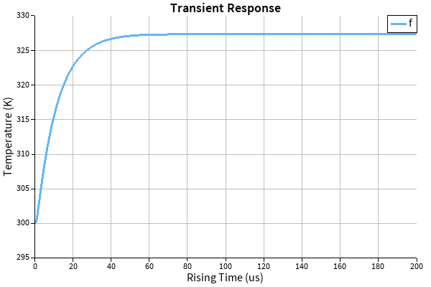
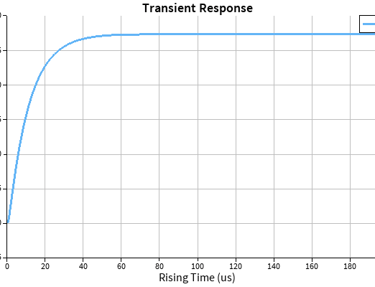
Transient Response Characteristics : Evaluating switching speed and temporal dynamics through step-response analysis.
Thermal time constant: τ = 10 μs (63.2% rise to 318 K)
Practical rise time: 20 μs (10-90% transition)
Settling time: 50 μs (99% of final temperature)
Maximum switching frequency: ~25 kHz for full thermal settling
Faster operation possible with partial switching schemes
Frequency Domain Analysis
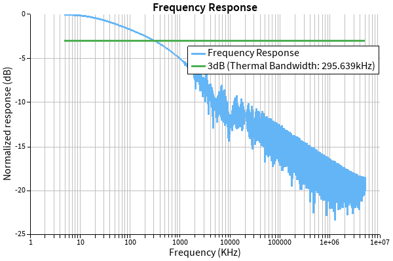
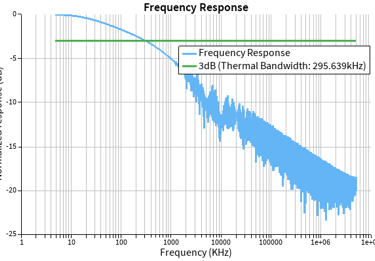
Determining modulation bandwidth through sinusoidal power excitation.
3dB thermal bandwidth: 295.6 kHz
Phase shifter supports modulation up to ~300 kHz
Roll-off at higher frequencies reflects heat diffusion limits through SiO₂
Thermal transfer function: H(f) = ΔT_AC(f) / ΔP_AC
Thermo-Optic Coupling
Establishing the relationship between temperature and optical effective index.
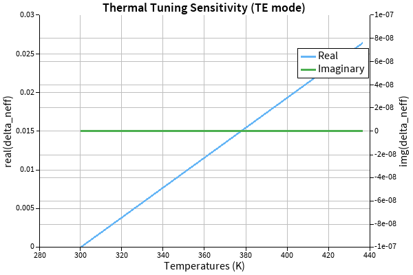
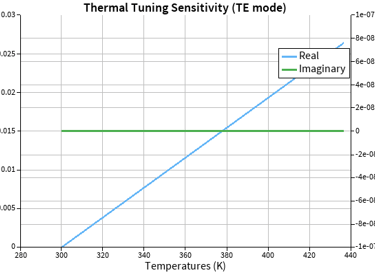
Effective thermo-optic coefficient: dn_eff/dT = 1.69 × 10⁻⁴ K⁻¹
Temperature sweep range: 280-440 K
Coefficient slightly lower than bulk silicon due to partial mode confinement
Direct relationship between temperature and phase through 200 μm heated length
Power Efficiency
Calculating the complete electro-thermal-optical transfer function to determine switching power requirements.
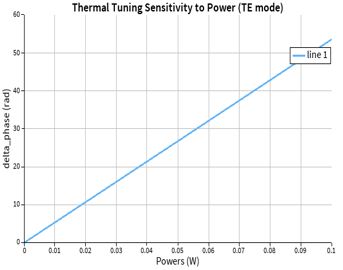
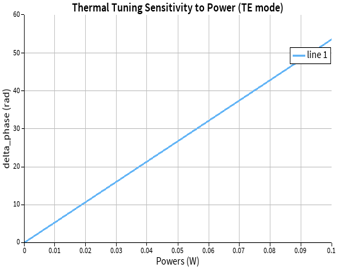
Phase tuning efficiency: dφ/dP = 520 rad/W
Power for π phase shift: P_π ≈ 6.0 mW
Phase shift at 100 mW: ~52 rad (16.5π)
Linear scaling confirmed across power range
Competitive with literature values (2.5-7.6 mW)
The phase shifter demonstrates competitive performance across key metrics when benchmarked against state-of-the-art thermo-optic designs. The switching speed of 20 μs directly matches rise/fall times reported in recent publications, confirming the design's viability for practical switching applications.
Power consumption of 6.0 mW for π phase shift positions the device in the mid-range of current implementations—significantly better than traditional designs but higher than some advanced geometries employing suspended waveguides or heat-recycling architectures that achieve sub-3 mW operation.
The thermal bandwidth of approximately 300 kHz provides adequate speed for reconfigurable optical switching in data center and photonic computing applications, where switching times in the microsecond range are typically acceptable. While the design falls short of the MHz-range modulation speeds achievable with electro-optic or carrier-injection mechanisms, it offers critical advantages in CMOS fabrication compatibility, design simplicity, and thermal stability.
These trade-offs make the design well-suited for applications prioritizing integration density and manufacturing scalability over absolute switching speed.
Final Thoughts
This project provided hands-on experience with the complete photonic device design workflow—from fundamental physics simulations through system integration. The biggest technical challenge was mastering the Lumerical toolchain and understanding the interplay between thermal dynamics, optical mode behavior, and material properties. While I encountered limitations in creating a fully automated compact model due to software restrictions, I developed effective workarounds and validated the design through multiple simulation approaches. The results demonstrate that thoughtful thermal engineering can achieve low-power, high-speed phase shifting suitable for next-generation photonic switching fabrics.
Connect
Explore my projects and coursework for insights.
afiah468@gmail.com
+970-689-1697
© 2025. All rights reserved.